Theorem 1 (i)7/5
for infinitely many n, whatever ξ > 0 is
4290 = 2351113
- One-step graph certificate, four stages
- Lean: checked by the kernel
Research project · Number theory · Computer-assisted proof
Pick any real number ξ > 0. Multiply it by 7/5 again and again, and keep only the integer part each time. The resulting sequence always contains infinitely many composite numbers — and so do the ones for 5/2 and 5/3. The proof supposes that from some point on no term is divisible by any of a few small primes, traps every such sequence in a finite graph, and prunes that graph until nothing is left.
01The result
In 1967 Forman and Shapiro proved that ⌊(3/2)n⌋ and ⌊(4/3)n⌋ contain infinitely many composite numbers, by arguments that also work after multiplying by any ξ > 0; Dubickas and Novikas added 5/4. For 7/5 they treated the nearest integers, and for 5/2 a shifted sequence; for 5/3, Novikas’s thesis treats the nearest integers. This work proves the statements for the plain integer parts. What was known, and what is new →
Theorem 1 (i)7/5
for infinitely many n, whatever ξ > 0 is
4290 = 2351113
Theorem 1 (ii)5/2
for infinitely many n, whatever ξ > 0 is
40112098026 = 23711131719232931
Theorem 1 (iii)5/3
for infinitely many n, whatever ξ > 0 is
1484147626962 = 2371113171923293137
Corollary 2For every ξ > 0, all three of ⌊ξ(7/5)n⌋, ⌊ξ(5/2)n⌋ and ⌊ξ(5/3)n⌋ contain infinitely many composite terms: a term larger than 37 that shares a factor with its modulus is composite, and the terms grow without bound.
Theorem 3For 7/5 there is even an explicit waiting time: a composite term within 428 + 12L(P) steps.
02In context
Composite numbers in sequences like these have been studied since 1967. On the left, the earlier results this work builds on or is compared with; on the right, what this paper adds.
Known before
New in this paper
03Try it
Type any positive number. The page computes the terms exactly, and marks each composite term with the smallest certificate prime that divides it. No list of terms can prove the theorem — that is what the finite certificate is for — but you can watch the marked terms keep coming.
3 composite, divisible by this certificate primecomposite, no certificate primeprime
04The method
Suppose, for contradiction, that from some point on no term of ⌊ξ(7/5)n⌋ is divisible by 2, 3, 5, 11 or 13. Call the terms from that point on an exceptional tail. (Its terms need not be prime: 323 = 17 × 19 is divisible by none of the five.) The proof shows, in three steps, that no exceptional tail exists.
Write Qn for the n-th term. The carry cn = 5Qn+1 − 7Qn is always one of the eleven integers −4, …, 6. So an exceptional tail obeys finitely many local rules: the residues modulo 4290, the fractional parts and the carries fit together in only finitely many ways.
New for rational basesCompare: Stephan, base 7
A state records the residue of a term modulo 4290 and which of K equal cells contains its fractional part; an edge is a legal step with its carry. Every exceptional tail becomes an infinite walk in this finite graph — for 7/5 it starts with 960 × 32 = 30,720 states.
Nonperiodicity lemma: Dubickas–Novikas 2005Pruning certificate: new
An infinite walk eventually stays inside one strongly connected component. If every walk there would make the carries periodic — impossible for a true sequence, by an elementary nonperiodicity lemma already in Dubickas–Novikas (2005) — the component is removed. What remains is refined, each cell split into four, and the test is repeated. For 7/5, the fourth stage keeps nothing: no exceptional tail exists.
New
For ⌊ξ(5/2)n⌋ a direct graph over all ten primes would have 30,656,102,400 states. The word-labelled method starts instead from four vertices and just three carries, −1, 1 and 3 (a term not divisible by 2 is odd, and the carry after an odd term is odd), lets each edge carry a whole word of carries, contracts deterministic paths exactly, and adds one prime at a time — checking the remainder at every intermediate term of every word. The largest graph it builds has 2,856,938 vertices, and its output is empty. The same method also gives a second proof for 7/5.
New
For ⌊ξ(5/3)n⌋, a term not divisible by 2 or 3 leaves just three carries, −2, 2 and 4, and three cells are enough to start. But with forward contraction alone, the graph for the last prime, 37, would have 313,651,296 vertices. So the certificate for 5/3 also contracts chains of vertices that have only one way in: a walk through such a vertex must have arrived along that one arrow, so the words can be joined backwards, just as corridors are joined forwards. Contracting in both directions keeps the largest graph at 21,077,909 vertices. At the prime 37, all 14,920 components with loops pass the test, and the output is empty.
In August 2026, shortly before this paper, Ralf Stephan posted a preprint proving that ⌊ξ7n⌋ contains infinitely many composite numbers for every ξ > 0. His method shares several ingredients with this one: a finite graph of residues (modulo 2 · 3 · 5 · … · 31), built by adding one prime at a time; rank functions that a checker verifies in place of proving graph algorithms correct; and a Lean verification that runs the finite computation with native_decide. The difference is what happens to periodic behaviour.
| Aspect | Stephan (2026) · base 7 | This paper · 7/5, 5/2 and 5/3 |
|---|---|---|
| States of the graph | residues | residues and fractional-part cells; every true sequence gives a walk, but a walk need not be a sequence |
| Parts in which every walk is periodic | kept: periodic digit patterns really occur, with no term divisible by a prime up to 31 | deleted: the carries of a true sequence are never periodic |
| What is left | a core of 371,702 states | nothing |
| Why composites follow | Dubickas’s return theorem (2009): a periodic digit pattern forces composite terms | a fixed set of primes divides infinitely many terms |
| A fixed set of primes that works for every ξ | none exists for base 7 (Dubickas–Jonuška 2022) | {2, 3, 5, 11, 13} for 7/5, {2, 3, 7, 11, …, 31} for 5/2, and {2, 3, 7, 11, …, 37} for 5/3 |
| Lean | every numbered statement; the finite computation by native_decide | Theorem 1 and Corollary 2; the 7/5 one-step certificate in the kernel, the word-labelled runs by native_decide |
Stephan’s computation is not used in any proof of this paper; the paper’s introduction compares the two methods. Stephan’s preprint · its Lean files
05Waiting time
New in this paper
Theorem 3 If P = ⌊ξ⌋ > 13, then some 0 ≤ n ≤ 428 + 12L(P) has gcd(⌊ξ(7/5)n⌋, 4290) > 1, and that term is composite.
Applied from any term onward, it says that a composite term arrives within 428 + 12L(QN) steps of any term QN > 13: the gaps between composite terms grow at most like the logarithm of the terms. The proof builds one more graph — 491,520 states and 891,990 arrows, whose blocks can be stacked in 65 levels — and adds up, exactly, the time a walk can spend at each level.
06Reach and limits
New in this paper
The paper also proves theorems about the certificate method itself, for a general base a/b.
With its operations fixed precisely, a finite certificate exists exactly when, for some cell count and some finite set of primes not dividing 2ab, every cyclic component of one explicit graph passes the phase test. Contraction, prime powers and the primes dividing 2ab never enlarge what can be certified.
The method can never terminate when a ≥ 2 rad M. With the primes of 4290, for example, it certifies none of the fractions (14k+1)/(10k+1) with k ≥ 613, although they approach 7/5.
Two carry words can combine into pseudo-orbits that no graph can exclude, unless extra primes are added. Their product R must satisfy
These results say that a fixed procedure does not terminate. They are not counterexamples to any arithmetic statement, and they do not assert that any base has only finitely many composite terms. They map out where finite certificates of this kind can and cannot reach.
New
The certificate for 5/3 shows that it belongs to the certifiable class of the normal form, without building that graph’s 413,857,382,400 vertices. In the other direction, two carry words of lengths 119 and 134 give pseudo-orbits that survive every graph built from the primes up to 23, so any certificate of this kind for 5/3 needs a prime of at least 29. Whether 29 is enough is not known.
07Further results and open problems
NewIn the spirit of Dubickas 2009
For any coprime a > b ≥ 2: if the carry sequence of an orbit has a recurrent tail, the orbit has infinitely many composite terms (Theorem 46).
New
If 6 < ⌊ξ⌋ ≤ 540, one of the first 41 terms of ⌊ξ(6/5)j⌋ is composite; if 9 < ⌊ξ⌋ ≤ 718, one of the first 19 terms of ⌊ξ(9/7)j⌋ is (Theorem 47).
New
For the family (6t+3)/(6t+1), which contains 9/7, the statement for all coefficients reduces to whether an explicit integer program always halts (Theorem 58).
08Verification
Every finite computation was carried out by two implementations whose scientific cores were written separately, and their complete outputs were compared element by element — not by counts, and not by hashes.
theorem floor_seven_fifths_visits (ξ : ℝ) (hξ : 0 < ξ) (N : ℕ) :
    ∃ n : ℕ, max N 1 ≤ n ∧ 1 < Int.gcd ⌊ξ * (7 / 5 : ℝ) ^ n⌋ 4290 := by
  exact finite_success_visits 7 5 4290 (by decide) (by decide) (by decide)
(by decide) mainFiniteSuccess ξ hξ N# file identity: the package manifest and the file hashes
python3 -B reproduce.py verify
# preflight: unit checks and selected small computations
python3 -B reproduce.py check --output /tmp/floor-paper-check
# every finite result, with the two implementations compared element by element
python3 -B reproduce.py recompute --output /tmp/floor-paper-fullEach command runs under fixed limits: 600 s and 8 GiB per command, and 1800 s in all for check, 3600 s for recompute, which includes the 5/3 computation and writes about 10 GB of graph data. The Lean proofs are built separately with Lean 4.29.1 and a pinned Mathlib. See REPRODUCE.md, COMPUTATION.md and FORMALIZATION.md.
09Explainer videos
Four animations walk through the paper, each in English and Japanese; a longer Japanese explainer covers the basics at high-school level.
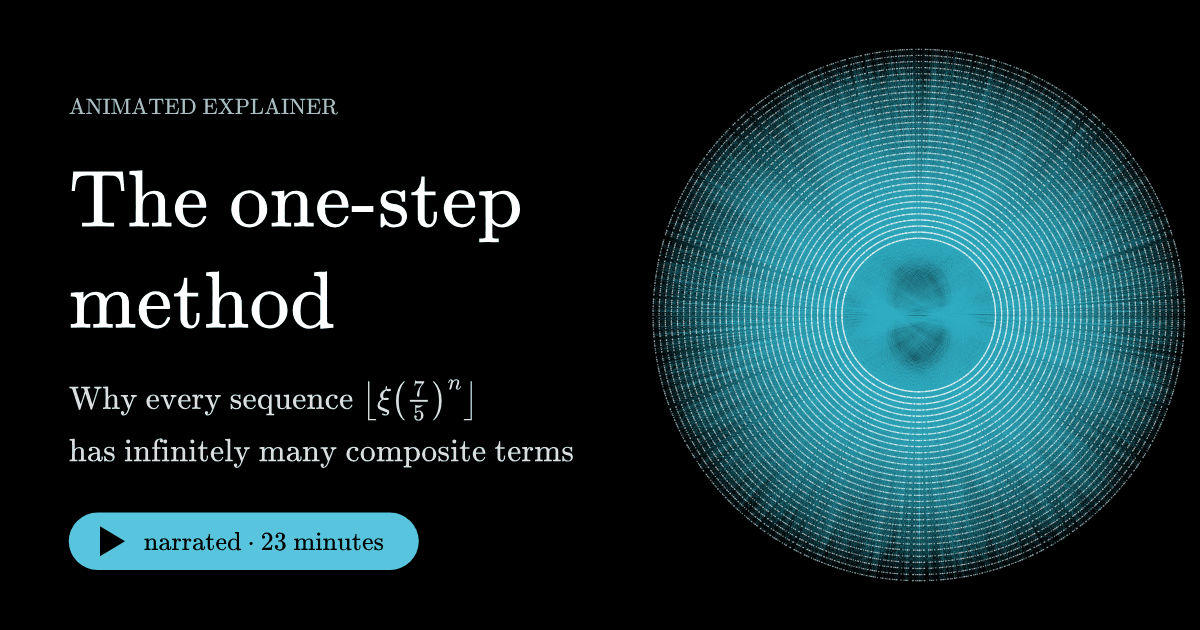
Why every ⌊ξ(7/5)n⌋ has infinitely many terms divisible by 2, 3, 5, 11 or 13: a finite graph, pruned stage by stage until nothing is left.
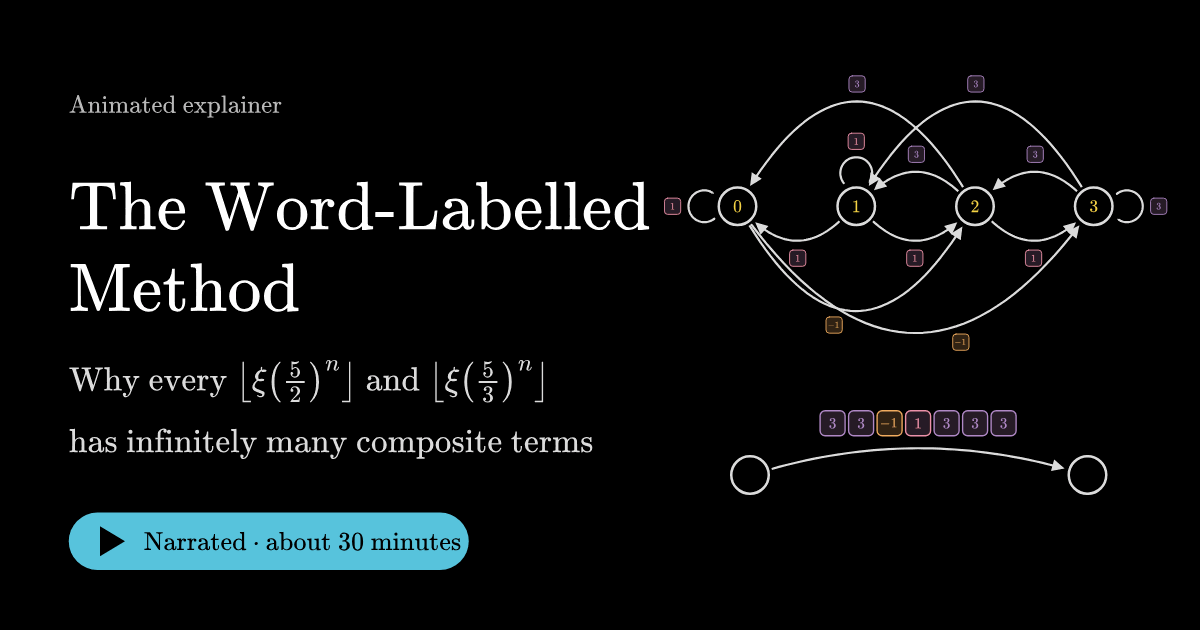
⌊ξ(5/2)n⌋ and ten primes: a four-vertex graph whose edges carry words, lifted one prime at a time. Then ⌊ξ(5/3)n⌋, where chains with only one way in are contracted as well, and how large the graphs get with each method.
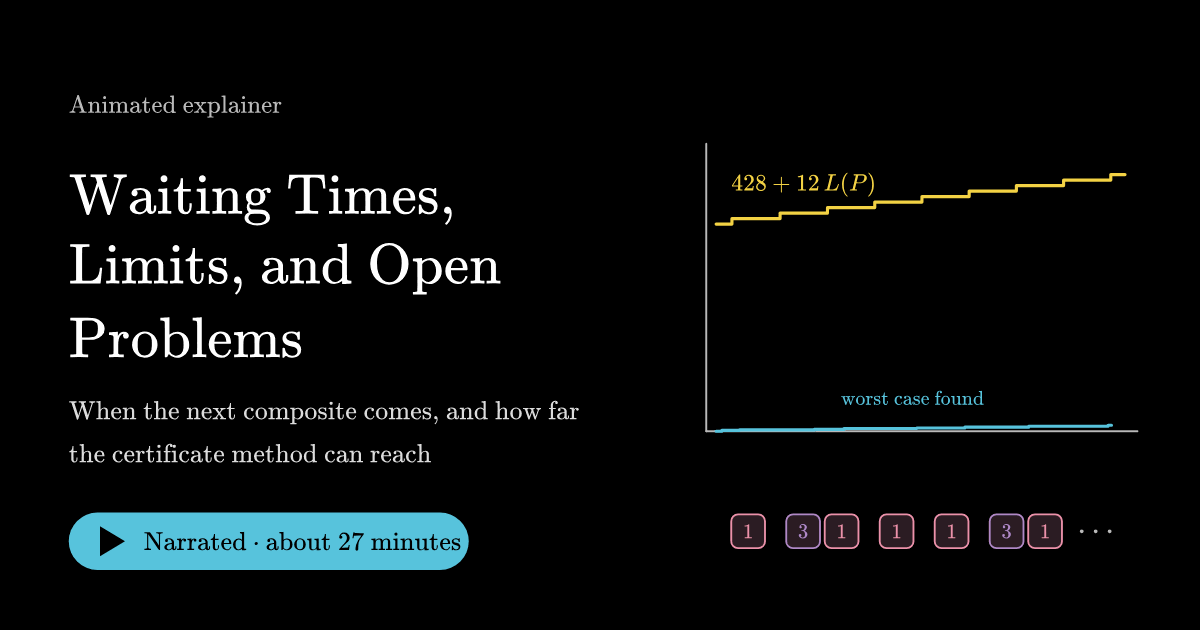
When the next composite comes, how far the certificate method can reach and what stops it, and what is still open.
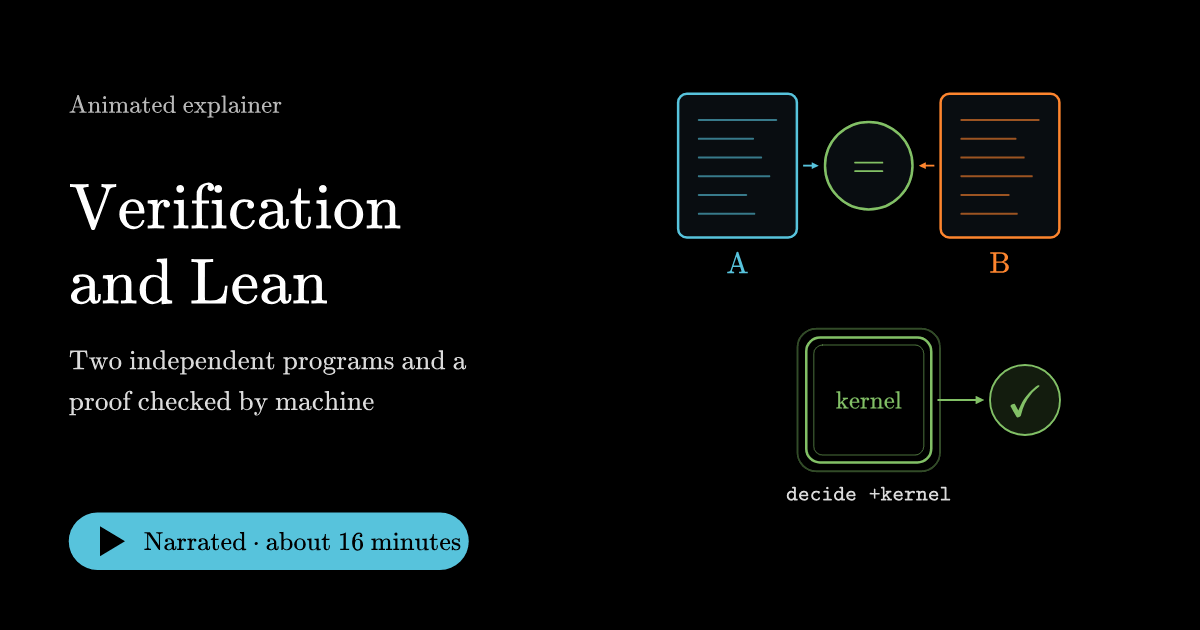
Two independent programs, a proof checked by machine, and exactly what each layer does and does not guarantee.

In Japanese, for readers with high-school mathematics, with the accompanying PowerPoint slides (99 slides). It covers 7/5 and 5/2, not 5/3.
10Paper, code, citation
Yuri Odagiri. Finite graph certificates for composite terms in rational floor sequences. 2026. doi:10.5281/zenodo.22997709
@misc{odagiri2026finite,
  author    = {Odagiri, Yuri},
  title     = {Finite graph certificates for composite terms in rational floor sequences},
  year      = {2026},
  publisher = {Zenodo},
  doi       = {10.5281/zenodo.22997709},
  url       = {https://doi.org/10.5281/zenodo.22997709}
}11Provenance
The paper’s acknowledgments describe its provenance in detail. It grew out of the author’s question whether every Mills number is irrational — a question the paper does not resolve.
After that initial conjecture, the mathematical development, the computation programs, the exposition and the Lean formalization were all carried out by AI systems. The internal reviews were automated critiques, not independent review by human mathematicians. The author has personally confirmed that the Lean proofs are accepted by Lean, and asks readers to assess the arguments, the reproducible computations and the formal proofs themselves.
For version 3.0.0, which adds 5/3, the author proposed reversing the search: looking for bases that admit a certificate, instead of trying to prove preselected ones. The search and the certificate for 5/3 were produced by GPT-6 Pro in ChatGPT; the second implementation, the Lean formalization and the integration into the paper were carried out by AI through Claude Code.
The explainer animations and this page were also produced with AI assistance.